Showing posts with label Ben Siegel. Show all posts

Wednesday, February 14, 2018

You're Stage What?

My name is Ben Siegel, and I’m the stage manager for Twelve Angry Jurors. When I tell people that I am stage managing, I often get answered with a “You’re stage what?” If you are in the crowd that has never heard of a stage manager before, are curious about what a stage manager’s specific duties are for a teen show, or just want insights on the show from a different perspective, you’re in the right place! I’m going to share with you some of my primary duties during each phase of the process, specifically for an STC teen show.

Over the course of the entire process, I am in charge of keeping us on schedule. This includes making sure that we do not spend too long on a specific portion of a rehearsal, that every production team member gets time to adequately cover what they need to during production meetings, and making sure that performances start on time. Another one of my jobs is keeping track of everybody’s conflicts and making sure that everybody is in attendance when they need to be. I am also the guy who sends out all the e-mails. But sending out a bunch of messages isn’t what makes stage managing so fun; it’s knowing that everything you do is for the purpose of making the show run smoothly.

During rehearsals, I compose reports for the designers and staff members. These inform them of any notes that the director or I have for them. Maybe a rehearsal prop broke. Maybe we realized that one of the set pieces squeaks when it is moved (We had this issue with our chairs :)). Maybe one of the lights needs refocused. Whatever needs communicated to designers, it’s my job to make sure they know about it.

During early rehearsals, one of my main responsibilities is taking blocking notes. I need to have the most up to date copy of the script, complete with all of the movements that the actors make over the course of the story and the exact time that they make these movements. During later rehearsals when the blocking is more solidified and memorization dates approach, I start taking line notes. We, of course, strive to have the lines said in our final production match the exact words written in the script as much as possible. I take note of any times when this is not happening and send out a report to the actors that detail these errors. In earlier stages of memorization, I am also in charge of giving actors their lines if they forget them while we are working a scene.

I also lead production meetings - meetings between the designers, the staff, and myself. I serve as, more or less, the moderator of the discussion, ensuring that each member of the production team gets a chance to share anything that they need to that particular week. I also make sure that each production team (costumes, set, props, dramaturgy) is on track with their deadlines. During the meeting, I take note of any reminders that I should give production team members, any decisions that we reach, and any key possibilities that are brought to the table. I write up another report detailing these ideas and send it to the production team.

Now, rehearsals and production meetings are coming to an end. This Sunday, we start technical rehearsals! Tech rehearsals are really exciting because we get to see the entire show come together; however, they have a reputation for being incredibly stressful and even chaotic. My job is to make sure that everything runs smoothly and make the process as stress-free as possible. Tech week really becomes a stage manager’s time to shine. I need to effectively take charge to ensure that everything stays organized during our last few rehearsals before performances.

During performances, a stage manager would typically call the cues. This means that they would take note of every light and sound cue in the production and, over headset, tell the light and sound board operators when it is time to go. For this particular production, there are very few technical cues and I led the lighting design process, so I will be running the board myself. Before performances, I assist with mopping the stage, charging glow tape, making sure that all props are set where they need to be, and similar routine tasks. Essentially, I make sure we are ready for our audience.

It has been such a pleasure to work with this group of dedicated and talented artists, and I have learned a ton from my participation with the show. I can’t wait to share this story with you!

Ben Siegel
Stage Manager

Wednesday, January 31, 2018

Welcome to the Jury Room

For Twelve Angry Jurors, we are bringing back the Story Theater Company blog - an opportunity for the community to get an inside look at our rehearsal process! During our last month leading up to performances, we will have designers and actors writing pieces that allow you to join us on this journey!

Our first two months of the rehearsal process have been incredible! I have had the privilege of watching the characters develop into convincing human beings with their own motivations, circumstances, and obstacles. The characters are truly coming to life and bringing me to the edge of my seat, even after the watching a scene for the fifteenth time.

One of the unique aspects of teen shows is that students ages 13-18 make up the production team and the cast. Each cast member is on one of four production teams - costumes, props, set, or dramaturgy. Every Saturday, we have a production workshop where the cast and production team work on the technical elements of the show.

For this show, our student production team leaders include Quinn Harbison (costume designer), Julia Divine and Jack Wanamaker (prop masters), Travis Cooper (set designer), and myself (stage manager). We are also led and mentored by a fantastic group of older theater makers, including Vivian Cook (director), Mat Wymore (technical director), Sarah Bennett (design mentor), and Lori Sulzberger (managing director).

Despite being set in the 1950’s, this play has been especially interesting to explore due to its relevance today. Ultimately, we have found that this play explores the way we treat one another. It has caused us to reflect on our own interactions, and we believe that this may be the case for the audience too. Among the specific issues that are discussed are justice, racism, and elitism.

I am so excited to see this rehearsal process continue to unfold, and I hope you are too! If you are interested, please check in for new blog posts weekly.

Ben Siegel
Stage Manager

Wednesday, February 1, 2017

A Look Behind The Scenes of Our Antigone

And I begin my tenth show at STC… This time, though, I will not be on the stage. In Our Antigone, I have the opportunity to work as assistant stage manager and lighting/sound designer. This has already given me a look into the side of the theater that I have only explored a few times, all of the happenings behind-the-scenes.


In this production, we have a wonderful team that is full of ideas, consisting of: stage manager, Maria Werner Anderson; set designer, Travis Cooper; costume designer, Morgan Reetz; properties master, Allyson Goodman; make-up designer, Sarah Schoppe; and lights/sound designer and ASM, myself. Additionally, all of the actors are participating on one design team (sets, costumes, props, or dramaturgy). Lastly, there are, of course, the adults and ISU students overseeing our process. In this production, we have Vivian M. Cook as our director, Sarah Bennett as our technical director, Lori Sulzberger as our managing director, and Charissa Menefee as the playwright for this original adaptation.


Teen shows are a very unique opportunity for various reasons. Perhaps the most notable is that the production team is made up of teens. The show that the audience experiences depends on the work of the students in every area of the production, since all of the “non-adult” roles mentioned above are being carried out by students. Every Saturday, there is a production meeting, which is followed by a session of work time for each of the design teams. This is the time when all of the ideas that are developed by the designers and further considered in production meeting come to life, as the entire ensemble works together to create the atmosphere of Our Antigone.


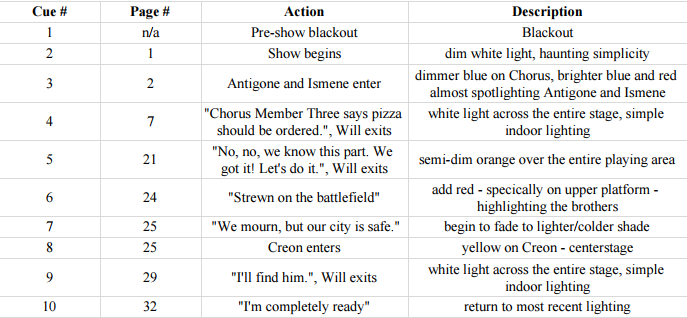
Each designer follows a very specific path, meeting many deadlines along the way. Personally, I have been working on lights and sound. This week we did not have rehearsals, as Vivian was at KCACTF, so I was given a wonderful opportunity to put additional time into my design work. After carefully considering each scene, I completed the initial draft of my cue list. This is a document that lists every lighting cue that I plan to include in the show, the action that occurs directly before the lights are changed, and a brief description of the change that occurs when the cue is hit. Here are the first ten cues in the production, to give you a general idea of the work I have been doing:Screenshot 2017-01-27 at 8.02.23 PM.png
So far, I have designed twenty-seven lighting cues for this production. However, I believe that one of the most important skills to apply when working on designs is flexibility. I am confident that many ideas will develop and change throughout this process.


I began the design process by researching the Greek ideal for lighting. I discovered that the shows were performed outdoors, in an open-air setting. This seemed to be an obstacle, as we are obviously not performing outside. However, I learned that they would purposefully perform their shows at certain times and days, so the outdoor lighting would influence the atmosphere of the show in an effective manner. It is upon this idea that I based my lighting concept for Our Antigone.


In each scene, I consider the ideal placement of the Sun in relationship to the mood of the scene. I explore many details of the scene to inform this choice. For example, a private scene may have more dim lights, while a public scene may have brighter light. Or a private scene may have contrasting lights on the key players of the interaction and the chorus. I also look at the emotional intensity of the scene and what ancient Greek associations were between colors and ideas. For example, I found that yellow, blonde, and gold were associated with gods and kings. Therefore, I made an informed choice to put yellow light on Creon during a scene where he is demonstrating power over the public.


Rehearsals are looking fantastic, and I can’t wait to continue to face the many challenges that are coming up during this process. I hope to see you all there!


-Ben Siegel

Lighting/Sound Designer and Assistant Stage Manager