The creation of our production of Almost, Maine so far has been one of the most interesting theatrical processes I’ve experienced. A huge part of Almost, Maine is communication--in the script, in production work days, and in rehearsal.
The script of Almost, Maine explores the ability (and often inability) of the people in Almost to communicate with one another. One of my favorite exercises we did early in rehearsals dealt with the difficulty of communication, especially in emotionally challenging situations. In this exercise, Mabel and I stood next to a white board, dry-erase markers at the ready, surrounded by the cast. Kivan told everyone to call out everything they could think of related to love. The board quickly filled up with words like happy, friendship, difficult, partnership, butterflies, love, kissing, cuddling, sharing, awkward, hard, etc. Eventually Kivan stopped us. He said, “Good job, guys.” Then he eerily chuckled. He told us all to scoot back and become the audience as he brought a chair forward, placed Ryan in it, and then told Ben S. he had to tell Ryan he loved him without using any of the words written on the board. If he said any of the words written, he would have to start over. Ben, Elizabeth, and I each had to do this. The audience collectively became very anxious as the confessor struggled to communicate to their partner; we all wanted them to do well and be able to say what they needed to say, but there was always the worry that they would grab onto a word they could not use and lose it all. Being on the inside was even more stressful. I felt like I was grappling; I was searching for words that weren’t there but there was the constant need to express, without the ability to do so. When I originally began, “difficult” was one of the first words I said, so I immediately had to go back and start again. This exercise gave me a clearer understanding of an issue these characters are constantly dealing with, and the constricting feeling that comes with not being able to communicate.
As both actors and members of the production teams, we are able to be involved in all different sides of the production and interact with multiple leaders. In addition to Kivan (our director), there is Maria (the stage manager), Mat and Megan (the technical directors), Hannah (the producer), Zoey (set designer and set team leader), Clove (assistant set team leader), Elizabeth and Ali (costume designers/team leaders), Allyson (prop designer/team leader), and Jayna, Ryan, and Zander (dramaturgy). During the first couple work days, Zoey explained her design to us and asked for some input on ideas for painting and arrangement. We discussed the different scenes of the play, where they take place, what set pieces might be required, and how we could communicate the time and atmosphere of the scene through the set. Mat, Megan, and Kivan would all occasionally come through, join the discussion, ask questions, and offer their input. When we began to look for platforms and flats, Zoey told us the plan and then delegated tasks to us as we found and needed to adjust them. The dramaturgy has shown us a few presentation on their findings so far, including a powerpoint about the Northern lights and a scene-connection map. It’s awesome to see all the different parts of the production come together from the inside and be able to actually aid in creating the physical world of the play as a production member in addition to living in the world as an actor.
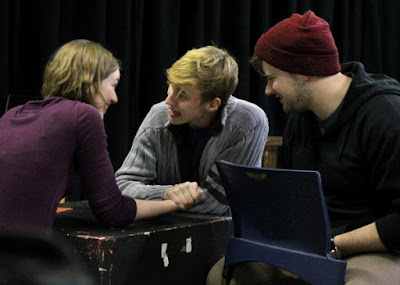
In rehearsals, communication is an entirely different story. In my rehearsal with Ben S. for Seeing the Thing and in the rehearsal I watched with Ben Teske and Mabel for Where it Went, the first thing Kivan had us do was play games. For Seeing the Thing, Kivan had us arm wrestle and keep each other from scoring a pillow-in-the-laundry-basket goal while in wheely-chairs. For Where It Went, after having Mabel and Ben T. stare into each other’s eyes for an extended amount of time, Kivan instructed them to move mats from one side of the room to the other--crossing paths without direct interaction, and then Kivan sat them both down, back-to-back with linked arms, and told them to pull each other until they reached what they wanted. While playing games may seem irrelevant to some, participating in these activities not only warmed us up, but helped us understand our scenes as well. These “games” were actually each an exercise with a specific set of objectives and given circumstances designed to reflect and explore the objectives and relationships in our scenes. When we worked on one of these exercises, we were each given a line of dialogue (mostly direct lines from our scenes) to repeat back and forth while we pursued our goal in the game. This technique of repetition was originally taught by the acting teacher Sanford Meisner to elicit honest reactions from actors and get away from the intentional, rehearsed inflections that can make acting false. In these exercises, you are not allowed to “act” the lines you are saying. Just repetition: listening and responding. Seeing the Thing begins with Dave (the character Ben S. plays) trying to convince Rhonda (the character I play) to let him go inside her house; Rhonda does not want Dave in her house. After arm-wrestling once with no words, Kivan gave Ben the line “Let’s go inside” and me the line “this is far enough.” He told Ben to get my arm all the way down to the table and told me to no longer try and push his arm down, but just prevent his arm from getting any closer to the table with mine. As we both actively pursued what we wanted (our objectives), the words became a vocalization of the action--not as lines, but what we actually needed to help us.
After these exercises, we went through the scenes by unit (small chunks of the scene revolving around the same action or idea) sans script. Working on Almost, Maine without our scripts for the first month of rehearsal has been one of the most interesting parts of the process so far. After analyzing the script and breaking it down into units and beats, we found we actually knew the progression of the scene well without the lines. Kivan essentially had us improvise the scene unit by unit. Initially, I was pretty nervous to go through the scene this way. However, once we actually got into it, it was rather freeing. Without the barrier of holding a script and constantly looking down at my lines or the stage directions, the blocking process became easier and more exciting to explore. We made many discoveries through this process about what characters were trying to say with their lines, moments that change the tempo of the scene, and how the characters move and interact onstage. I definitely think we’ve made more growth initially rehearsing this way than if we had dove in immediately with the script, with just writing down and practicing premeditated blocking plans.
The process has been incredible so far, and I can’t wait to see what comes next with this show!
Lena Menefee-Cook
Rhonda/set team member

