Saturday, February 11, 2017

Actor's Choice

This week, we have been working on running the show memorized. We have gotten to the end, but we are definitely not done. I learn more and more every time I run my scene. I realize that Haemon is trying to get his dad, Creon, to spare his fiance, but I wondered if Hameon was just trying to save his fiance, or if he really agreed with Antigone. He had just found out and came to argue with his dad. I asked Vivian, and she said it's actors choice.
Actors get choices like this. We think about the circumstances, and sometimes, when we don’t know what the tactic is, we have to make one up, but once we make that choice, we have to stick with it 100%. I had a little trouble with lines the first time I ran my scene memorized, but that was okay because we had Maria and Ben on book for us. Once I got the blocking put with the words, it went pretty easily.
We talk about it a little bit in the script that at a Greek tragedy, the audience is supposed to leave renewed. Like a good cry. It makes feel exhausted, but it's needed. I didn’t think much of that line until we ran my scene, and I argue with my father and have so clear objectives, and I left and I felt that exact thing. I felt so renewed. I love it when all the circumstances are clear and the have obvious objectives.  It makes the acting so; I want to say easy, but I think the word is driven. When the character is driven, you feel that as you are acting it. It just makes you happy as an actor.

Travis Cooper
Hameon/Eddie/Lead Set designer

Wednesday, February 8, 2017

Dramaturgy /ˈdraməˌtərjē,ˈdräməˌtərjē/

Our Antigone cast is roughly 1 month into blocking. That means, we’ve made a great deal of progress; the production is beginning to incorporate several aspects envisioned by our set, props and costumes departments. Not only are we accomplishing great amounts during rehearsal times, but during our Saturday morning workshops as well. One of the greatest aspects of teen shows at STC is that cast members design the set, props and costumes for the show all by themselves, the show is built by teens, for teens. However, one production team doesn’t take part in the physical aspects of the production, but rather the intellectual side… and that’s the dramaturgy team.
This is my third teen show being on the dramaturgy team, and each year I’m enthralled by the new things I learn and what we get to research. As the dramaturgs, it’s our job to study “the theory and practice of dramatic composition”. We dedicate ourselves to the analysis of the script, history, and language of the play. This year, we go all the way back to 440 B.C.E. when Sophocles first wrote Antigone. These past few weeks during workshops, our dramaturgy team has read, and interpreted the Oedipus Rex Series or the Theban plays, a trilogy written by Sophocles between 440 B.C.E., and 405 B.C.E. We’ve also read the story of The Seven Against Thebes written by Aeschylus in 467 B.C.E. In order, the plays goes like so: Oedipus the King, Oedipus at Colonus, The Seven Against Thebes, and Antigone.
Antigone is last in the series, so it’s especially crucial for our cast to have information about their characters from the earlier plays. The best way for them to thoroughly understand their personal character development though, would be for them to read each of the plays. Sometimes, that’s not possible, and that is where the dramaturgy team comes in to help out. We provide a basis of knowledge about key plot points, and and summarize the series for our cast members. We are open to questions, and are happy to research. That right there, is what makes dramaturgy fun for me. We hope to extend our knowledge within the next month of workshops, and be prepared for another presentation soon into the future. Go Dramaturgs!!
“There is a point at which even justice does injury.” ~ Sophocles  
Jayna Wanamaker
Messenger/Tracy

Dramaturgy

Saturday, February 4, 2017

Working With My Character

This week, we have been working more on putting together the lines and blocking of the play. I don’t come in until the second half of the play, and we didn’t get to that scene the other night, so I took that time to further myself. In the past week with no rehearsal, I worked on memorizing, and I am still in the middle of reading Oedipus at Colonus. I also got to look at my character. Vivian taught us about body centers and how everybody has a center. The centers are head, chest, stomach, and hips. I think that my character, Hameon, is a mainly a head center but with a second of a chest center.
We don’t get to see a lot of how Hameon acts. We only get to see how he reacts to Creon’s words. Creon has just sentences his fiancee to death. He is smart by not barging in there mad. You can tell he has thought through his words before he talks to his father, making sure to tell him that he is above all reasonable and that no wife could give Hameon better council that he, then subtle saying that Antigone may deserve honor rather than death. He is very careful as to what he said to his father because he knows his father is a king with a temper. Vivian has also told me that the relationship between father and son was different back then. It is not like the relationships we have today. He is thinking of Creon as the king, and not the father.


It is a lot like the scene between Creon and the Messenger. He knows that he can be killed or put in jail for lies. In a way, I am trying to get Creon to change his mind without upsetting him. If I upset him, he could just kill Antigone, put me in jail, banish me, or maybe even kill me. Creon has been known to lose his temper from time to time.

We ran the scene where Creon finds out about my death. It started a discussion. Should we feel bad for him? His wife and only son just killed themselves, but he had it coming. He sentenced Antigone to death, who is not only his niece, but his son’s fiancee. There are a lot of discussions to be held in these plays.


-Travis Cooper
Haemon/Eddie and Head Set Designer

Wednesday, February 1, 2017

A Look Behind The Scenes of Our Antigone

And I begin my tenth show at STC… This time, though, I will not be on the stage. In Our Antigone, I have the opportunity to work as assistant stage manager and lighting/sound designer. This has already given me a look into the side of the theater that I have only explored a few times, all of the happenings behind-the-scenes.


In this production, we have a wonderful team that is full of ideas, consisting of: stage manager, Maria Werner Anderson; set designer, Travis Cooper; costume designer, Morgan Reetz; properties master, Allyson Goodman; make-up designer, Sarah Schoppe; and lights/sound designer and ASM, myself. Additionally, all of the actors are participating on one design team (sets, costumes, props, or dramaturgy). Lastly, there are, of course, the adults and ISU students overseeing our process. In this production, we have Vivian M. Cook as our director, Sarah Bennett as our technical director, Lori Sulzberger as our managing director, and Charissa Menefee as the playwright for this original adaptation.


Teen shows are a very unique opportunity for various reasons. Perhaps the most notable is that the production team is made up of teens. The show that the audience experiences depends on the work of the students in every area of the production, since all of the “non-adult” roles mentioned above are being carried out by students. Every Saturday, there is a production meeting, which is followed by a session of work time for each of the design teams. This is the time when all of the ideas that are developed by the designers and further considered in production meeting come to life, as the entire ensemble works together to create the atmosphere of Our Antigone.


Each designer follows a very specific path, meeting many deadlines along the way. Personally, I have been working on lights and sound. This week we did not have rehearsals, as Vivian was at KCACTF, so I was given a wonderful opportunity to put additional time into my design work. After carefully considering each scene, I completed the initial draft of my cue list. This is a document that lists every lighting cue that I plan to include in the show, the action that occurs directly before the lights are changed, and a brief description of the change that occurs when the cue is hit. Here are the first ten cues in the production, to give you a general idea of the work I have been doing:Screenshot 2017-01-27 at 8.02.23 PM.png
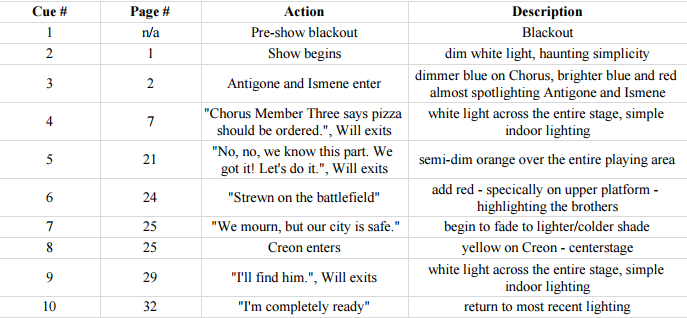
So far, I have designed twenty-seven lighting cues for this production. However, I believe that one of the most important skills to apply when working on designs is flexibility. I am confident that many ideas will develop and change throughout this process.


I began the design process by researching the Greek ideal for lighting. I discovered that the shows were performed outdoors, in an open-air setting. This seemed to be an obstacle, as we are obviously not performing outside. However, I learned that they would purposefully perform their shows at certain times and days, so the outdoor lighting would influence the atmosphere of the show in an effective manner. It is upon this idea that I based my lighting concept for Our Antigone.


In each scene, I consider the ideal placement of the Sun in relationship to the mood of the scene. I explore many details of the scene to inform this choice. For example, a private scene may have more dim lights, while a public scene may have brighter light. Or a private scene may have contrasting lights on the key players of the interaction and the chorus. I also look at the emotional intensity of the scene and what ancient Greek associations were between colors and ideas. For example, I found that yellow, blonde, and gold were associated with gods and kings. Therefore, I made an informed choice to put yellow light on Creon during a scene where he is demonstrating power over the public.


Rehearsals are looking fantastic, and I can’t wait to continue to face the many challenges that are coming up during this process. I hope to see you all there!


-Ben Siegel

Lighting/Sound Designer and Assistant Stage Manager

Saturday, January 28, 2017

Blocking to Memorizing

This week we finished our blocking, which was a lot of fun. Blocking means that we went through and put down actions into our words. We write out where we are moving and with what lines. It does more than that though. Blocking is really helpful because it gives a chance to run the scenes with our scripts to give us a chance to look at it before we have to go off memorizing our lines.

In teen shows, or pretty much Story Theater Company production, the kids get to pick the blocking with the director. We get to help suggest things, we get to be the naysayer, and we get to question what Vivian is doing. Though most of the time Vivian has it right on the nose, we sometimes don’t feel it works and we want to change something, we have the opportunity.

On top of the blocking, the next step is memorization and that is one of the hardest parts. There are so many different ways to memorize. The best way that I have found is repetition. You read through it and say what you know, and when you get stuck, you look back at the script and keep going.

We didn’t have rehearsal this week, so I have taken this time to look over the other plays and to memorize. I have a big scene where I stand up to my father Creon because he sentenced my fiance to death. I have a big monologue. The thing I need to do most right now is to go over it with Josh. I can memorize the monologue pretty easily, but it’s harder to memorize a conversation where lines go back and forth. We are on our way to having this play in the bag.

-Travis Cooper
Haemon/Eddie, Lead Set Designer

Saturday, January 21, 2017

Adventures of the Set Waffles

For this play, I am not only acting, but I am also the lead set designer. In teen shows, everybody is put into a group and it is primarily teen lead. Vivian directs of course and we have adult supervision to make sure we are being safe, but other than that, the teens are pretty much running the show. We have teens doing set, costumes, makeup, and dramaturgy. Each one of these are crucial to the production. Last year, I was in the teen show Almost Maine and that was not only my first teen show, that was my first show. I was with the props crew on that show and I had a lot of fun, so I decided I would lead a group this year, and I got put on set.
I have some experience with tools and things like that because I work with my dad a  lot in the garage.  Last year I was on props, but all the groups connect. I realized this a little bit last year, but this year, being a lead designer, I realize just how much collaboration is needed between the groups. Colors on the set need to match the colors of the costumes. We talked a lot. I have the set already designed and part of it is made. We made a ground plane on the first day because Vivian needed to know what she was working with during blocking. It looks like this:


Screenshot 2017-01-19 at 8.58.50 AM.png


Vivian requested a lot of levels, so that’s exactly what I gave her. We have essentially a big set of platforms that rise in height as they go back against the wall. It is like a big staircase with little staircases coming off the sides. One of the challenges was that the script calls for two rose colored pillars. I included them, but now the trick will be to get Styrofoam and make shape it and paint it to look real. Sarah also knows a lot more about these thing than I do, so I am lucky to have her and my crew Asher, Gerrit, James, and Anika. We call ourselves the Set waffles and our catch phrase is “Bruh digity”. We are also working on giving each other nicknames. You can tell how close we are and that we all have a good time while being productive. I am very grateful for my team. They always help and get things done fast and efficient. I am so excited to see the whole set in its full beauty and I hope you all enjoy it as well.

-Travis Cooper
Hameon/ Eddie/ Lead set designer

Saturday, January 14, 2017

My Mind Baby

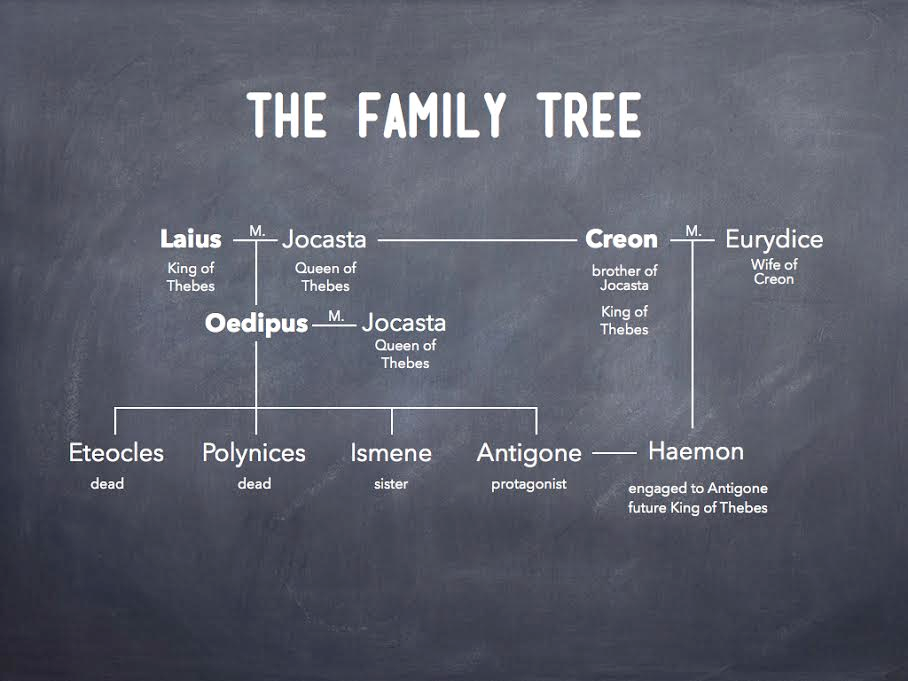
This first couple weeks of rehearsal have been very informative for me. I learned more about Greek Theater than I have in any of the Greek Theater camps I have been in. Greek theater is such a complex thing because it all connects. The first week, we weren’t working on my scene, so I took that rehearsal time to read the first play in the series of three. ANTIGONE is just the third play in a trilogy. I was interested because, in this play, it talks a lot about characters and past experiences that aren’t in the play. I wondered who they were, so I read the first play, and I realized that a mass majority of these characters are all in one family. So, to help me understand who is who, I made a family tree. It looks similar to this one.


I was confused, because according to the play, I am engaged to my cousin. So, I took my question to Vivian, and she has done a lot more research than I will even begin to do. This is just a little bit that I did to understand it, because I am not on dramaturgy, but I feel everybody should understand how their characters connect and relate to one another. Anyway, Vivian told me, that for the greeks, it was not unusual for cousins to marry each other. I did some research and it told me that they did this because they wanted to keep the royal blood in the family, but cousins were as close as they went (accept for the case of Oedipus, but that’s a different story) and this was usually an arranged marriage by the guardians. Each city had their own laws about marriage.

I think this story adaptation relates to me a lot. I think it would relate to any high school or jr. high student. The adaptation that was written I think specifically for STC kids. It covers everything from homeschoolers, to grades, to not understanding a script, and pizza. These are all things that STC kids deal with. We have homeschooled kids, we all have had our troubles with scripts, we all like pizza. There are  many other similarities in this, but you have to come see the show to see it. I hope you enjoy the show.
Travis Cooper
Hameon / Eddie / Lead set designer