Saturday, February 17, 2018

"What do you want?"

“What do you want?”

At first glance, this phrase may seem blatantly rude. You may consider it to be harsh, even. But in our production of Twelve Angry Jurors, it has been the single most useful sentence I have heard. How? It all comes down to one simple subject, a tiny piece of the puzzle that is the play. What is this piece? Characterization. What does it have to do with the play? Almost everything.

Twelve Angry Jurors is unique in the sense that most of the plot is driven by emotion. While other plays may have a plot in which the conflict itself spawns emotional reactions from the characters, 12AJ turns that dynamic upside-down. It cuts straight to the raw emotion of twelve unique individuals, all stuck in a hot room to decide the fate of someone they’ve never met. As you can tell, there’s a lot of layers there. And that’s just where the phrase, “what do you want,” comes into play.

Each and every character in the story has a reason for doing what they do. Every single person has an internal dialogue that is slowly molded into their agenda throughout the play. And so far, all of my fellow actors have been doing an amazing job at portraying this - all because of that seemingly-rude phrase.

Here’s how it works: imagine you have just sat down, program in hand, in the house of a theater. You’re excited, not knowing what’s about to happen onstage. Perhaps you have picked up a little knowledge about the play somehow, but ultimately you’re here to watch a magnificent piece of drama unfold. The lights dim, the actors walk onto the stage, and…

...the play is boring. So boring that you’re yawning. It’s clear that the actors are just saying their lines, and they have no understanding of what the characters are grasping for. They’re barely acting, just reciting the script and going through the motions. It’s almost exhausting to watch - and not in a good way.

Now, I’m not saying you’ve ever seen a play like this. Perhaps you’ve seen something close, but not to this extreme. In any case, you can rest assured that Twelve Angry Jurors steers quite clear of this, all because of our secret weapon of a phrase that we’ve been using all throughout our rehearsal process:

“What do you want? Why are you here? What is your character striving for in this moment? Why do they agree - or perhaps disagree - with what one of the other jurors just said? What are they trying to gain by saying this?”

Variations of this phrase have been used during every rehearsal. Furthermore, each actor has filled out several pages worth of character analysis guidelines, all with the specific goal of bringing these fantastically intricate characters to life. It’s been a lot of work, but it will have been worth it when you come see the play. Instead of watching fourteen people recite line after line, you’ll be watching the amazingly detailed narrative of a rag-tag group of people from different backgrounds, different beliefs, different morals, all coming together to decide on one of the most difficult decisions that can be thrust upon one’s conscience.

It’s thrilling, to say the least. It’s a story that’s definitely worth more than just one evening in the black box. It leaves you exhausted in the best way possible - all because of that one question that keeps nagging, keeps biting, keeps pulling away at the layers, until what’s left is the raw, unadulterated plot of twelve uniquely complex characters who have been assigned to accomplish the most daunting task of their life.

Gerrit VanDyk
Juror #12/Set Team


Wednesday, February 14, 2018

You're Stage What?

My name is Ben Siegel, and I’m the stage manager for Twelve Angry Jurors. When I tell people that I am stage managing, I often get answered with a “You’re stage what?” If you are in the crowd that has never heard of a stage manager before, are curious about what a stage manager’s specific duties are for a teen show, or just want insights on the show from a different perspective, you’re in the right place! I’m going to share with you some of my primary duties during each phase of the process, specifically for an STC teen show.

Over the course of the entire process, I am in charge of keeping us on schedule. This includes making sure that we do not spend too long on a specific portion of a rehearsal, that every production team member gets time to adequately cover what they need to during production meetings, and making sure that performances start on time. Another one of my jobs is keeping track of everybody’s conflicts and making sure that everybody is in attendance when they need to be. I am also the guy who sends out all the e-mails. But sending out a bunch of messages isn’t what makes stage managing so fun; it’s knowing that everything you do is for the purpose of making the show run smoothly.

During rehearsals, I compose reports for the designers and staff members. These inform them of any notes that the director or I have for them. Maybe a rehearsal prop broke. Maybe we realized that one of the set pieces squeaks when it is moved (We had this issue with our chairs :)). Maybe one of the lights needs refocused. Whatever needs communicated to designers, it’s my job to make sure they know about it.

During early rehearsals, one of my main responsibilities is taking blocking notes. I need to have the most up to date copy of the script, complete with all of the movements that the actors make over the course of the story and the exact time that they make these movements. During later rehearsals when the blocking is more solidified and memorization dates approach, I start taking line notes. We, of course, strive to have the lines said in our final production match the exact words written in the script as much as possible. I take note of any times when this is not happening and send out a report to the actors that detail these errors. In earlier stages of memorization, I am also in charge of giving actors their lines if they forget them while we are working a scene.

I also lead production meetings - meetings between the designers, the staff, and myself. I serve as, more or less, the moderator of the discussion, ensuring that each member of the production team gets a chance to share anything that they need to that particular week. I also make sure that each production team (costumes, set, props, dramaturgy) is on track with their deadlines. During the meeting, I take note of any reminders that I should give production team members, any decisions that we reach, and any key possibilities that are brought to the table. I write up another report detailing these ideas and send it to the production team.

Now, rehearsals and production meetings are coming to an end. This Sunday, we start technical rehearsals! Tech rehearsals are really exciting because we get to see the entire show come together; however, they have a reputation for being incredibly stressful and even chaotic. My job is to make sure that everything runs smoothly and make the process as stress-free as possible. Tech week really becomes a stage manager’s time to shine. I need to effectively take charge to ensure that everything stays organized during our last few rehearsals before performances.

During performances, a stage manager would typically call the cues. This means that they would take note of every light and sound cue in the production and, over headset, tell the light and sound board operators when it is time to go. For this particular production, there are very few technical cues and I led the lighting design process, so I will be running the board myself. Before performances, I assist with mopping the stage, charging glow tape, making sure that all props are set where they need to be, and similar routine tasks. Essentially, I make sure we are ready for our audience.

It has been such a pleasure to work with this group of dedicated and talented artists, and I have learned a ton from my participation with the show. I can’t wait to share this story with you!

Ben Siegel
Stage Manager

Sunday, February 11, 2018

An Ever-Changing Job

The Dramaturgy Team, in any show, can be a valuable resource for the cast. They can provide insight into the world of the play, or necessary context for the other production teams. I have been one of the dramaturgs for the past three teen shows now, and the experience has never been the same twice. Each show adds a new and exciting layer to the process, so the job never ceases to be fun for the team.

In Almost,Maine, our research consisted of looking into what cliches the script was centered around (not to mention a lot of the Aurora Borealis), while for Our Antigone, we read through the ancient Greek plays for backstory of the plot. And in this show, we’ve been thrusted into a whole new world of legal terminology and 1950s history. Additionally, everytime we give a presentation to the cast, it never feels like we are repeating ourselves or shoveling to them the same information over and over again.

The dramaturgy for this show is especially important, as it is, inherently, a period piece. Therefore, collecting information from this time period is vital for both the production teams-- as their work needs to look time-accurate, otherwise, certain aspects will feel a bit anachronous, and leave the audience feeling disoriented in space and time--as well as for the actors themselves, so they can know more about the world their characters inhabit, and thus, be able to make more honest decisions as they act. For instance, recently we presented a large chunk of information about the social environment of the time period. We thought this information would be useful for certain characters in identifying their circumstances and how others would react to them.

As a part of the Dramaturgy Team, one never finds themselves in a dull or boring moment. It’s such an important job, that varies from not just show to show, but week to week, as we tackle new questions and assignments. To be a dramaturg is to be stepping stone. A jumping off point to help the other members of the company in their own personal jobs.

Zander Reed
Foreman/Dramaturgy

Thursday, February 8, 2018

Backstage and Onstage

One of the things that is most unique about the teen show is the opportunity to expand and learn new skills. Not only can you act on stage and learn theater skills in a professional atmosphere, you also get hands on experience of building the show in all aspects. The opportunities offered are things such as set, props, costume, hair and makeup, lighting, dramaturgy,  and stage managing. I started the teen show experience with Almost, Maine. I was an actor and a member of the props team. The next year, during Our Antigone, I was an actor and lead set designer. This year, I am an actor and lead set designer yet again.


I find that once you become familiar onstage, it is a whole new experience working offstage. Working with props taught me problem solving skills and creativity. Becoming a team leader was a totally different experience for me. Not only did I learn set, I learned budget, time management, and cooperation with other teams. You never stop learning with the teen shows. Different shows require very different things from each team. The Antigone set was very different from the Twelve Angry Jurors set. Though most of the time, the set is listed out in stage description, there is always room for creativity with the help of my amazing set team.

.
Set Waffles minus Gerrit. From Left to right: James, Madison, Sarah, Travis

The thing I am excited for this year that is different from other shows is the simplicity of this set. We are working in the 50’s era, so technology and such isn’t nearly as advanced. The black box theater also adds an up-close and personal atmosphere so that the audience can pay attention to minute details in set, props, costumes, etc. The simplicity of this set allows for attention to detail. This is a simple jury room. It has simple things such as a working water cooler, a clock, a table, 12 chairs, and an opening window. Oh, and you can’t forget the trash can.

A bonus I have is being a part of the rehearsal process as an actor. I get to see what each character is going to be doing with the set, I get to see problems that might occur, and I get to fix them. The teen show is an altogether amazing learning experience.


Travis Cooper
Juror 2/Set Designer

Wednesday, January 31, 2018

Welcome to the Jury Room

For Twelve Angry Jurors, we are bringing back the Story Theater Company blog - an opportunity for the community to get an inside look at our rehearsal process! During our last month leading up to performances, we will have designers and actors writing pieces that allow you to join us on this journey!

Our first two months of the rehearsal process have been incredible! I have had the privilege of watching the characters develop into convincing human beings with their own motivations, circumstances, and obstacles. The characters are truly coming to life and bringing me to the edge of my seat, even after the watching a scene for the fifteenth time.

One of the unique aspects of teen shows is that students ages 13-18 make up the production team and the cast. Each cast member is on one of four production teams - costumes, props, set, or dramaturgy. Every Saturday, we have a production workshop where the cast and production team work on the technical elements of the show.

For this show, our student production team leaders include Quinn Harbison (costume designer), Julia Divine and Jack Wanamaker (prop masters), Travis Cooper (set designer), and myself (stage manager). We are also led and mentored by a fantastic group of older theater makers, including Vivian Cook (director), Mat Wymore (technical director), Sarah Bennett (design mentor), and Lori Sulzberger (managing director).

Despite being set in the 1950’s, this play has been especially interesting to explore due to its relevance today. Ultimately, we have found that this play explores the way we treat one another. It has caused us to reflect on our own interactions, and we believe that this may be the case for the audience too. Among the specific issues that are discussed are justice, racism, and elitism.

I am so excited to see this rehearsal process continue to unfold, and I hope you are too! If you are interested, please check in for new blog posts weekly.

Ben Siegel
Stage Manager

Thursday, March 2, 2017

My Challenges

Starting on Our Antigone was a new challenge. There is always something to work on or fix
in every play, and my challenge for this play was and is learning how to communicate clearly the
difference from my modern character, Claire, to my Greek character, Antigone. In this adaption
by Charissa Menefee the script continually changes from modern, where they are kids in a
rehearsal, to the Greek tragedy Antigone. At first I thought this switch wouldn’t be that difficult
because it seemed like a drastic change. But as I continued to work with the script and
rehearsed my blocking I realized that Antigone and Claire aren’t that different from each other.
We’ve talked about body centers and worked with them in our first couple of rehearsals. There
is head, chest, hips, and stomach. Claire has a head center with a secondary chest center. She
is always thinking, observing, and encouraging. She is trying to keep the play moving since their
director left so it can be successful, and this puts responsibility on her. Claire is a nerd and
throughout the play she loves giving information to her fellow actors about Greek drama to help
inspire them because it inspires her. It’s also been interesting to figure out how to distinguish
Claire from myself since I’ve found that I have the same center as well as secondary center.
Antigone leads with her chest and has a secondary head center. We’ve learned a lot about
Greek theater and how they hold themselves. The space around them is concrete and they
never move without a purpose. So when playing Antigone I have to stay grounded and focused
on my objectives. Antigone is constantly thinking about her brother and how she needs to do
what is right. Even if that means going against the king, Creon, and his authority. Expressing
this slight difference from leading mainly from my head to leading from my chest has been
difficult. But I’ve also found that if you take that point of change and not only use it in your body
but also in your mind it helps you to express the difference between your characters. So I can’t
just change how I stand but also how Claire thinks verses how Antigone thinks.

A couple of rehearsals ago, we did parts of the script double time, which means we say our
lines and do our cues twice as fast. I had never done this as an actress and I found that it
helped me more than I thought it would. Vivian has told us over and over that we need to know
our lines backwards and forwards so we can have fun with the play and explore. This exercise
helped me to know where in the script I’m having trouble spots with my lines so I can go back
and work on them.

As we head into tech week the stakes get higher but also there’s the excitement and
adrenaline of performances. I can’t wait to see the final results and I hope everyone can come
see this intriguing play of family, power, friendship, and courage in Our Antigone!

Lauryn Berger
Claire/Antigone and props person

Saturday, February 25, 2017

Finishing the Set

We are nearing the end of our regular rehearsals. It has been so fun and has all gone so fast. We are about to tech week already. We have one more Saturday work day. I have a lot to get done this Saturday still. My crew has been working really hard to get this set done. We have almost all of the platforms made and painted. We still have to do wood graining and make one more pillar and make it look all pretty. We have one more platform and a ramp to make. But the good news is that we can stay late next Saturday to get stuff done. You can see how much we have been doing by this picture.

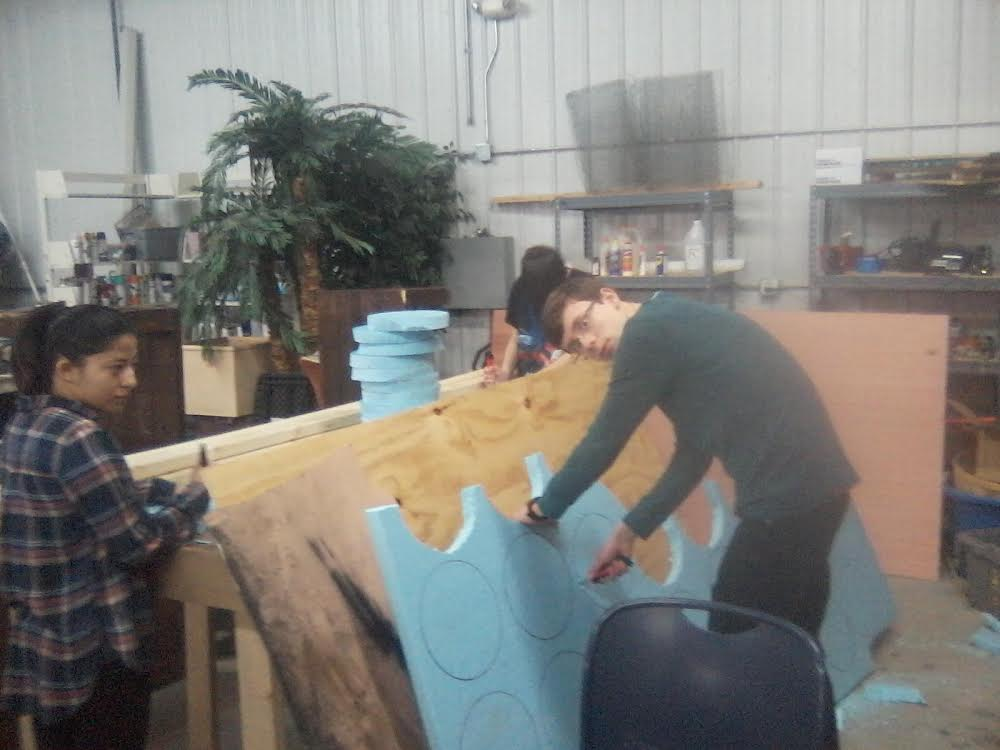
The set waffles making our pillars!- Anika, Gerrit, and James

We also get pretty messy. We paint, but luckily we have drop cloths.  This styrofoam was all over the place. We got it stuck to our clothes, all over the floor, and everywhere else. The best part of being a part of the process is that as you make the set, you get to see it in action during the week. As we make the set, they use it, which gives us a chance to problem solve. We had to add the ramp because the step down from the top platform was too big of a step. We had some creaky platforms, which we tried to solve as best we could, but it’s not easy to make it silent.

I am so excited to get the set done this Saturday and start tech week. We have been working really hard on this show, and I am really excited for everybody to see it! This has been such a fun experience for me.

-Travis Cooper
Hameon/Eddie/Lead Set Designer